Hays County is building a highway through our neighborhood.
The county's plan puts 45 mph freight and commuter bypass traffic directly alongside new elementary school bicycle routes on Darden Hill Road. That is not a design conflict that can be engineered away. It is a fundamental choice: build for the trucks, or build for the children. The county chose the trucks.
Phase 1 engineering is 80‑90% complete. Phase 2 — the extension through our community — is at 30%. The window to change this plan is closing. We need your support.
532 residents have signed the community letter. Sign and help save your community.
The County's Plan
They asked us. We answered. They ignored us.
Hays County's Improve 150 program calls for widening Darden Hill Road from a rural two‑lane road to a four‑lane divided highway with a median, shoulders, bike lanes, and a 45 mph speed limit. The county collected community input, documented our opposition, and advanced a plan that contradicts it.
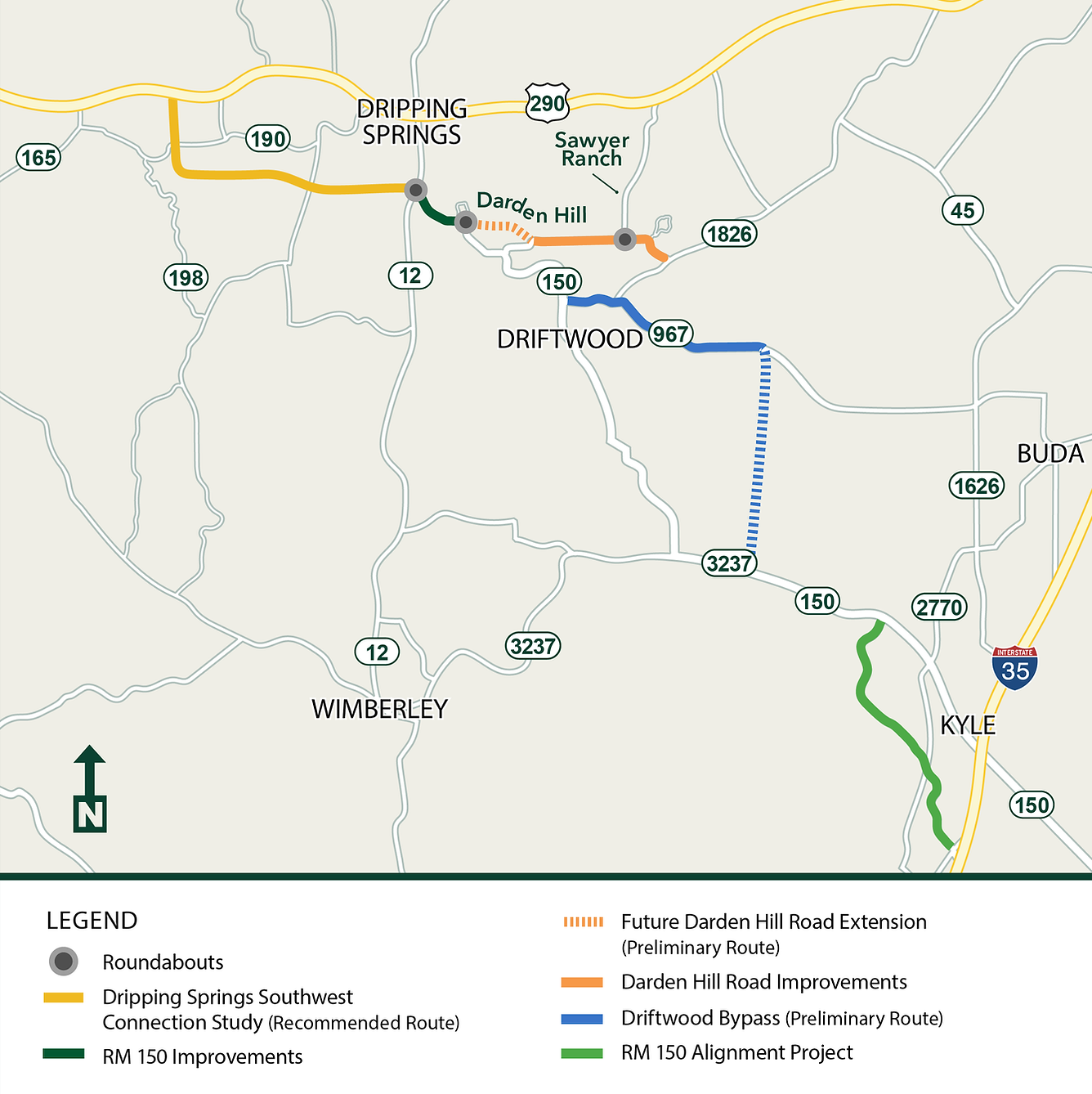
From the county's own planning documents
The 2013 Hays County Transportation Plan recommended only the addition of a center turn lane to Darden Hill Road — not a four‑lane expansion.
The CAMPO 2040 Regional Transportation Plan — the regional planning authority covering Hays County — classified Darden Hill Road as "Improve to MAD‑2": a two‑lane divided major arterial. Not four lanes. This was the regional consensus as recently as 2020.
The 2017 RM 150 West Character Plan, prepared by K Friese & Associates and accepted by the Commissioners Court on October 10, 2017, specified two‑lane configurations throughout the entire corridor — two 11‑ft lanes with a 14‑ft center turn lane in community zones, and two 12‑ft lanes with shoulders in rural zones. Not one cross‑section in the 72‑page plan proposes four lanes. The county‑appointed Citizens Advisory Panel, across 18 meetings with 340+ attendees, recommended roundabouts at major intersections specifically for their "documented safety benefits and speed reduction qualities" and because they "support the corridor's rural character compared to traffic signals."
This was not an early draft. The Character Plan was the final study, accepted by the Commissioners Court in October 2017 after nearly three years of engineering analysis and community engagement. Not one of its 72 pages proposes four lanes on any segment. Every cross‑section is two lanes. That was the conclusion — reached with full knowledge of the area's growth trajectory.
Residents were equally clear. At the December 2016 public meeting, a community member wrote about Darden Hill Road specifically:
"Keep Darden Hill Rd. 2 lane residential. Do not want to encourage commercial truck traffic on Darden Hill Rd. We are all residential on Darden Hill Rd."
— FM 150 West Character Plan, December 2016 Public Meeting Summary, p. 12
Another resident warned about what was already happening:
"Darden Hill is quickly becoming a thru‑way with cars zooming too fast. Straightening will encourage speed."
— FM 150 West Character Plan, December 2016 Public Meeting Summary, p. 12
The county collected this input across five public meetings with 530+ attendees and 450+ comments. Then it advanced a four‑lane plan that contradicts every one of its own studies, its own project team's assessment, and the documented opposition of the community it is required to serve.
Sources: Character Plan Archive · Darden Hill Project Page
The project phases
Phase 1 — Darden Hill Improvements
RM 1826 → Sawyer Ranch Rd
Four-lane divided roadway with median, shoulders, and intersection improvements. Engineering is 80‑90% complete, targeting Q3 2028 to coincide with the new high school opening.
Phase 2 — Our Primary Concern
Sawyer Ranch Roundabout → RM 150
Four-lane widening through our community, extending the road to FM 150 at Woods Loop. Engineering is at ~30% — the window to change this design is still open.
A planned future extension would complete the corridor, creating a continuous high‑speed route from RM 1826 through to RM 12 via FM 150. The county describes this as "an improved connection" — but what it connects is 45 mph freight and commuter traffic to a road that runs directly past our homes and our children's schools.
The county's plan simultaneously builds bike paths for elementary schoolers and a 45 mph four‑lane arterial for heavy traffic — on the same road. That is not an engineering tradeoff. It is a contradiction.
The county's stated project goals
- “Improve safety, mobility, and connectivity between RM 1826 and RM 12”
- “Design improvements that will enhance the transportation experience in the area”
- “Coordinate with property owners and the community to share information and determine feasible solutions”
We share the first two goals. We are here to ensure the county follows through on the third.
Source: improve150.com/darden
4 lanes, divided
2 lanes + turn lanes
45 mph
35 mph
Regional corridor
Residential road
No restriction
Weight limit enforced
45 mph adjacent to campuses
35 mph, community scale
Not conducted
Required before advancing
None planned
Study first, then mitigate
Higher
Lower
Why This Matters
What this plan does to our community
Children on bicycles. Trucks at 45 mph. Same road.
The county's own design calls for bike paths alongside a 45 mph four‑lane arterial — directly adjacent to new Dripping Springs ISD school campuses. These are the deadliest road configurations for pedestrians in the United States.
fatality risk for a pedestrian struck at 40 mph
fatality risk for a pedestrian struck at 20 mph
Tefft, B.C., "Impact Speed and a Pedestrian's Risk of Severe Injury or Death," AAA Foundation for Traffic Safety, 2011. Risk is substantially higher for children and elderly. NHTSA data shows the majority of U.S. pedestrian fatalities occur on arterial roads (FARS, 2023). Research published in Accident Analysis & Prevention identifies four‑lane roads near schools as a significant predictor of child pedestrian injuries (Rothman et al., 2015).
This is not hypothetical. A resident directly across from the Creek of Driftwood neighborhood entrance was struck and killed while making a left turn out of her driveway by another driver. The county's plan would raise the speed limit at that same location. The county may argue that a straighter, flatter road improves visibility. But the danger to residents is not sightlines — it is closing speed. A driver approaching at 50 mph (the realistic speed on a 45 mph four‑lane arterial) covers 73 feet per second. A resident pulling out of a driveway or neighborhood entrance must now cross four lanes instead of two, at higher speeds, with heavier traffic including trucks, and less margin for error. Smoother geometry makes the road safer for through‑traffic. It makes it more dangerous for the people who live on it. And at the end of this four‑lane corridor, the county's plan funnels every one of these high‑speed trucks into a roundabout that is literally the entrance to an elementary school.
A Safe Routes to School assessment is an established federal best practice for road projects near schools — and to our knowledge, one has never been conducted for the Darden Hill expansion. Three Dripping Springs ISD campuses sit on or adjacent to Darden Hill Road — Cypress Springs Elementary (11091 Darden Hill Rd, 660+ students), the planned new high school site directly adjacent to it, and Sycamore Springs Middle School about two miles north on Sawyer Ranch Road. All three served by the road the county wants to turn into a 45 mph four‑lane arterial. The county has applied SRTS principles to other Hays County projects but not to the one with arguably the most direct school impact.
Growth is not an excuse for a highway
The county cites population growth and Cypress Springs Elementary (660+ students, opened 2021) as justification for four lanes. But growth was already anticipated when the county paid K Friese & Associates — professional transportation engineers who model growth projections for a living — to prepare the 2017 Character Plan. They knew about the development pipeline. They still specified two lanes. If population growth invalidates the 2017 study, why did the county commission it?
The county's own numbers can't keep their story straight. Its 2023 Darden Hill open house cited “267% population growth by 2045.” Its Southwest Connection study uses the same figure. But its April 2026 response to this community cited “68% by 2050” from the Texas Demographic Center — a dramatically lower number for a dramatically longer timeframe.
The City of Dripping Springs' own 2021 Traffic Study (HDR Engineering) recorded 1,600 vehicles per day on Darden Hill Road. The same study's short‑term recommendation for Darden Hill was "no short‑term improvements." For context, standard transportation engineering references estimate that a two‑lane road with turn lanes handles approximately 15,000 vehicles per day at acceptable levels of service. Darden Hill carries 1,600. Even RM 1826 — the higher‑traffic road that feeds directly into Darden Hill — carried only 7,700 vehicles per day on the approaching segment in 2022, according to TxDOT's own RM 1826 Feasibility Study.
Nobody is arguing Darden Hill needs zero improvements. A two‑lane road with turn lanes handles significantly more traffic than a bare two‑lane road — that is exactly what the county's own engineers recommended. The jump from "center turn lane" to "four‑lane divided highway" is not a proportional response to growth. It is a different kind of road entirely.
And the county's own justification undermines itself. The county has pointed to the new elementary school as a reason for widening — but building a 45 mph four‑lane arterial past the school you are citing as justification is incoherent. More children on the road is an argument for lower speeds and fewer lanes, not a highway.
We purchased homes on a two‑lane rural road in the Hill Country. A four‑lane, 45 mph corridor will permanently degrade the safety, quiet, and property values that define this community. We did not buy homes on a highway.
And wider, faster roads do not just accommodate traffic — they generate it. This is established transportation engineering, known as induced demand. A four‑lane highway will attract regional through‑traffic that currently uses other routes. The county is not responding to traffic. It is inviting it — directly past our homes and our children's schools.
A highway built one "improvement" at a time
Look at the system, not the segments. The county is simultaneously widening RM 1826 to four lanes, Darden Hill Road to four lanes, and RM 150 to four lanes. Connect them at 45 mph and what you have is a regional highway from US 290 to RM 12 — running directly through a residential community. The county describes this as "an improved connection between RM 1826 and RM 12." That is a highway function. A road improvement serves the people who live on the road. A "connection" between two distant highways serves through‑traffic.
Each project justifies the next. TxDOT's own RM 1826 feasibility study states that four‑lane connecting roads create "potential capacity issues" for a two‑lane RM 1826 — so RM 1826 must also be widened. The logic is circular: each road is justified by pointing to the next. Nobody asks whether the system should be built. They just build each piece and call it an "improvement."
The county has now made this logic explicit. In its April 2026 response, the county stated that Darden Hill must be four lanes to “tie safely and consistently into RM 150 improvements and the future Dripping Springs Southwest Connection, both of which are planned as four‑lane facilities.” But the Southwest Connection is itself unfunded beyond a 20% conceptual study, with the county's own documents stating that the next phases could take “3 to 7+ years.” The county is building a four‑lane highway now to match a road that may not exist for a decade.
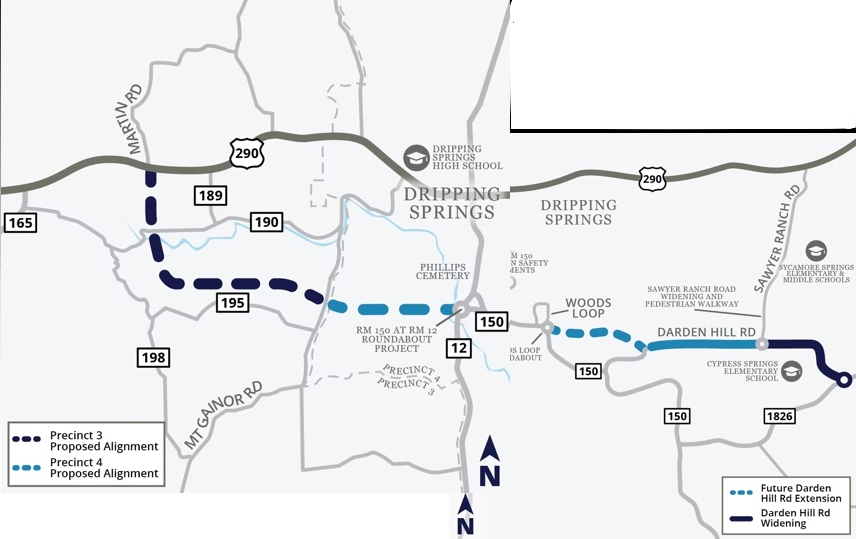
The community recognized this pattern in 2017. From the Character Plan:
"For most, the concerns rise above individual and direct impacts to properties and extend to a more holistic sense that a series of seemingly minor projects might collectively and incrementally change the very fabric of the landscape along this cherished corridor."
— FM 150 West Character Plan, Final Report, Section 3.4.1, p. 26
The county documented that concern. Then it did exactly what the community warned against.
It's not just roads. The WTCPUA's own Capital Improvements Program plans a $8 million, 16‑inch water main along Darden Hill Road by 2034, adding capacity for 5,200 homes that don't exist yet. The road serves the development. The development justifies the road. The water line makes both possible. Commissioner Walt Smith, who represents Hays County Precinct 4, also serves as Secretary/Treasurer of the WTCPUA board.
This matters because Darden Hill Road is currently a quiet, two‑lane rural road with modest traffic. The county's capacity projections assume a future where every connecting road is a four‑lane highway — then use that assumption to justify making Darden Hill one too. But if you don't build the highway, you don't get the highway traffic. The choice to build four lanes is not a response to existing conditions. It is a decision to create new ones.
No noise study has been conducted
TxDOT's own traffic noise analysis for RM 1826 — the road that connects directly to Darden Hill — found that widening would result in traffic noise impacts at residential locations, with predicted levels reaching 70 dB(A) against a federal threshold of 67 dB(A). It then determined that noise barriers were either not reasonable (too costly per benefited home) or not feasible. Impacted residents simply have to live with it.
Darden Hill Road is currently a quieter road than RM 1826. A four‑lane expansion would produce an even larger relative increase in noise for the homes along it. Yet to our knowledge, no traffic noise study has been conducted for the Darden Hill expansion. According to a written summary of a February 2026 community meeting with Commissioner Smith circulated by the Driftwood Historical Conservation Society, no sound barriers are planned — even as the widened road moves closer to homes in the Creek of Driftwood and other neighborhoods. Residents deserve to know the projected noise impact on their homes and properties before the design advances further — not after construction begins.
RM 1826 residents are already reporting the effects. At TxDOT's June 2024 public meeting, one homeowner described the noise as "unbearable at times in our own back yard" and another reported that "the foundation of my home is constantly vibrating to the point of rattling pictures off the walls." These are residents on the road that feeds directly into Darden Hill.
Environmental note: Darden Hill Road sits within the Onion Creek watershed and the Barton Springs Contributing Zone (TCEQ 30 TAC Chapter 213), with potential Golden‑Cheeked Warbler habitat (federally endangered) and karst features connecting surface water directly to the Edwards Aquifer. Higher‑volume roads produce significantly greater stormwater runoff carrying heavy metals and petroleum compounds into this sensitive watershed.
Voters said no. The county found a way around it.
The county designed this four-lane plan before securing the money to build it. At its May 2023 public open house, the project slides stated explicitly: "There is currently no funding identified for right of way acquisition or construction for Darden Hill from RM 1826 to Sawyer Ranch Road."
In 2024, Hays County put a road bond on the ballot. A group of Hays County residents, represented by Bobby Levinski — Senior Staff Attorney for the Save Our Springs Alliance — challenged the election. A judge voided the bond in 2025 for violating the Texas Open Meetings Act. Rather than respect that outcome, the county approved up to $240M in Certificates of Obligation — public debt that does not require voter approval — to continue advancing these projects.
Under Texas Local Government Code §271.049, a petition signed by 5% of registered voters can force the county to hold an election before issuing COs.
Every signature strengthens the community's position with county officials.
Add Your NameThe Alternative
We are not saying no. We are saying do it right.
Whether this road ends up with two lanes or four, it must be designed for the community that lives on it — not as a 45 mph freight corridor past three schools. The county changed the plan from two lanes to four without coming back to the community that spent three years telling them what we needed. At minimum, these conditions must be met:
Community Endorsement
The Driftwood Historical Conservation Society has formally endorsed the community's position — supporting a Super Two configuration, a 35 mph speed limit, and opposing the four‑lane design. “A four‑lane divided highway is unnecessary for the projected use of this corridor and is fundamentally inconsistent with the rural character of the Darden Hill area.”
Publish current traffic data
The most recent traffic count on Darden Hill Road — from the City of Dripping Springs' 2021 Traffic Study — recorded 1,600 vehicles per day using 2018 data. The county's own 2023 open house materials cited traffic growth percentages from 2010–2015 without publishing a current count. No one has conducted an updated traffic study for this road. The county should not advance a four‑lane design without current data to justify it.
Complete a traffic noise study before advancing the design
TxDOT's own noise analysis for the connecting RM 1826 corridor found traffic noise impacts at residential locations, with predicted levels exceeding the federal 67 dB(A) threshold — and determined that noise barriers are not cost‑effective. Darden Hill is a quieter road where the relative impact would be greater. Residents have a right to know the projected noise impact on their homes before the design passes the point of no return.
Conduct a Safe Routes to School assessment
Three DSISD campuses sit on or adjacent to this corridor. Safe Routes to School assessments are an established federal best practice for road projects near schools — funded through SAFETEA‑LU, the FAST Act, and the Bipartisan Infrastructure Law. To our knowledge, one has never been conducted for the Darden Hill expansion.
Reduce to two lanes with turn lanes — a “Super Two” configuration
In transportation engineering, a "Super Two" — a high‑quality two‑lane road with wide shoulders and center turn lanes at key intersections — is the standard design for growing rural corridors. It is exactly what the county's own 2017 Character Plan specified: two 11‑ft lanes with a 14‑ft center turn lane in community zones. The CAMPO 2040 Regional Transportation Plan also classified Darden Hill as a two‑lane road. Turn lanes solve the actual capacity constraint — intersections — without turning a neighborhood road into a highway.
Set the speed limit at 35 mph
Three schools sit on or adjacent to this road. A 45 mph speed limit next to elementary schoolers on bicycles and teenagers learning to drive is indefensible regardless of how many lanes are built.1 Sawyer Ranch Road is posted at 35 mph today, and the February 2026 community meeting summary reports it was reduced from 45 to 35 mph as schools and neighborhoods developed in the same precinct. The families on Darden Hill deserve the same standard of safety.
Establish a truck weight limit
Heavy freight has no place on a road where children bicycle to school. A weight restriction ensures Darden Hill serves residential traffic, not regional trucking. The community raised this concern in 2016: "Do not want to encourage commercial truck traffic on Darden Hill Rd."
Remove the planned future extension
The extension completes a regional highway corridor from RM 1826 to RM 12. The community rejected a similar bypass concept in 2015 with a 322‑signature petition that forced the county to remove it from the plan. Building the same connectivity under a different name does not change what it is.
Re‑engage the community before finalizing a design
The 2017 Character Plan involved 530+ attendees, 450+ comments, and 18 advisory panel meetings over three years — all resulting in a two‑lane recommendation. The shift to four lanes happened without a comparable process. If the county's plans have changed, the community deserves to be consulted again before engineering reaches a point of no return.
Recent Community Meetings
The community is being heard
May 20, 2026
Twisted X Brewing Company
Community forum hosted by Hays County Judge Ruben Becerra. Judge Becerra walked through the history of the Darden Hill project and heard directly from residents.
April 14, 2026
Driftwood Community Center
Community meeting hosted by the Driftwood Historical Conservation Society. Commissioner Walt Smith speaking.
If you missed these meetings, you can still make a difference. Sign the community letter, contact your commissioner, and share this site with your neighbors.
Key questions the community is asking
- — Has the county conducted a traffic noise study for the Darden Hill expansion? TxDOT's analysis for RM 1826 found noise impacts at residential locations exceeding the federal 67 dB threshold.
- — Why does the current plan call for four lanes when the county's own 2013 and 2017 studies recommended two lanes?
- — Has the county prepared a cost‑benefit analysis comparing the four‑lane plan to a two‑lane alternative?
- — How does the county reconcile 45 mph traffic adjacent to school campuses with the stated goal of pedestrian and cyclist accommodation?
- — Why were Certificates of Obligation used to advance a project whose bond funding was successfully challenged in court?
Take Action
Don't wait until construction starts to find your voice
Engineering is at 30%. Right now, changes are routine. Soon, the county will say it's too late. If you live on or near Darden Hill Road, this is your moment.
Sign the Community Letter
The county collected our input and ignored it. Add your name to make sure they can't ignore us again. Read what your neighbors are saying →
Add Your NameContact Commissioner Walt Smith
Phone
(512) 858-7268Office
195 Roger Hanks Parkway
Dripping Springs, TX 78620
Additional steps
- — Contact Dripping Springs ISD school board and PTA regarding student safety near the proposed corridor.
- — Share this page with neighbors on Darden Hill Road and in the surrounding communities.
- — Print a flyer and post it on your mailbox, fence, or community board. In Driftwood, physical signage drives meeting attendance.
- — Notify local media — Hays Free Press, Austin American‑Statesman — about the community's concerns.